[ Stables / Cats: Their Points and Characteristics, with Curiosities of Cat Life, and a Chapter on Feline Ailments ]
William Gordon Stables (1840 - 1910) was a Scottish doctor and prolific writer of various sorts of works, including several books on dogs.
One would think a book about cats has no place being discussed on a website about Newfoundlands, but this is Gordon Stables we're talking about, and if you've read any of the discussions of his other works here at The Cultured Newf, you know what I mean. This was a man who LOVED Newfoundlands, and apparently would never pass up the opportunity to talk about them. Stables has four other works discussed here at The Cultured Newf: Ladies' Dogs as Companions (1879), Our Friend the Dog (1884), Aileen Aroon (1884), and the chapter on Newfoundlands in Henry Webb's Dogs: Their Points, Whims, Instincts, and Peculiarities (1872). See what I mean? :)
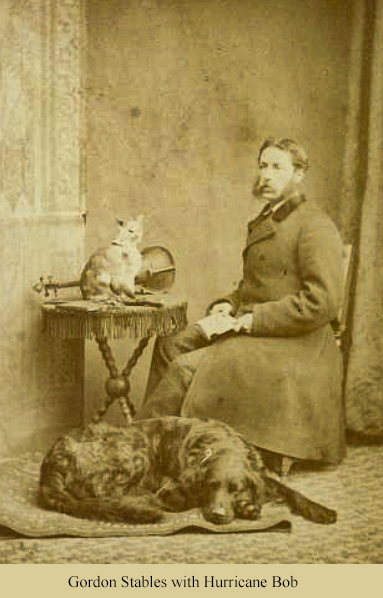
This image of Stables with his Newf "Hurricane Bob" and one of his cats served as the frontispiece to this book (1876 edition; London: Dean and Sons).
The first mention of Newfs comes as Stables introduces an anecdote about a cat that "rescued" the family's little boy by running to the mother and yowling piteously when the ill child falls off a sofa and onto a rug that he inadvertently gets tangled in, threatening suffocation: "The cat, mentioned in the following anecdote, was surely worthy of the Humane Society’s bronze medallion, as much as any Newfoundland ever was."
The next anecdote involves one of Stables' own Newfoundlands, Theodore Nero, and his cat, Muffie.
A dog will seldom dare to attack a cat while she is nursing her young. My own cat actually imposes the duties of dry nurse on my Newfoundland, “Theodore Nero.” His finely feathered legs make a delightful bed for them. He seems pleased with the trust too, and licks them all over with his tongue. In Muffie’s absence, he lies perfectly still, seemingly afraid to move lest he should hurt them. When they get a little older and more playful, they make tremendous onslaughts on his nose and ears and tail, which the honest fellow bears with the most exemplary patience, for he loves Muffie, although many a wild chase he gives her numerous lovers. He can’t bear “followers.”
The other day a playfellow of his, a large Irish water-spaniel, looked in at the door just to ask if he would come for a romp for an hour, as the sun was shining, the breakers running mountains high on the beach, and any number of little boys to throw in sticks to them. Theodore Nero was nursing. But Muffie went, and I should think that dog felt sorry he had ever turned out of bed at all that morning. The cat rode him at least fifty yards from her own door, battering him unmercifully all the way. Then she came back, and sang to Nero.
The next reference to Newfs comes in the chapter entitled "Fishing Exploits," but before telling a number of stories of cats catching fish, Stables makes this general observation.
Pussy is a very dainty animal, cleanly in the extreme, more particularly with regard to her personal appearance; and knowing better than any one that fur once wet is very difficult to dry, she does not care to dabble in the water like a duck or a Newfoundland dog.
In the chapter on "Classification and Points" Stables remarks that "In the pure Black cats, the hair is not so fine; and it is at times parted down the centre like that of a well-bred Newfoundland dog."
Stables next relates a story about how he met up with a neighbor, Paddy, who, with three other men, was about to be involved in a rather cruel bit of what they considered fun: sending a cat in a basket down a river, with their dogs in pursuit.
“It’s meself,” says Paddy, “that’s glad you’ve come, and by the same token, yonder come the boys with the cat.”
On looking round, sure enough, there were three more boys—of course “boys” is a mere figure of speech, they were all, including Paddy himself, grown-up men—with three more dogs, one of which, a large white-and-black Newfoundland, carried a basket in his teeth. Suspecting that some scene of mischief or cruelty was to be enacted, I asked Paddy to tell me, right straight away, what the game was to be. “Sure your honour,” said he, “it’s only this:—we put the cat in the tub, and float her down the strame, and send the dogs ahint her.”
It was in vain that I tried to persuade Paddy to give up a scheme which seemed to me little short of diabolical; for I fully expected to see poor pussy torn limb from limb in the water. Paddy’s reasoning was something after the following fashion:—
“If it’s the dogs you’re afraid of, sir, sure enough they’ll deserve all they’ll get, and more; if it’s the cat, then you needn’t be afraid at all, she’s been three times at it before. Och! she’s the raal taring blood-and-wounding captain of the butter-boat; besides, she has kittens at home, and that makes her the devil himself, sure. Moreover, sir,”—here he lowered his voice; “the boys is ugly boys, and they’ve ugly bits of timber below their flippers, and they wouldn’t let us spoil the sport for the dear life itself.”
So, making a virtue of necessity, I stopped to see the fun and fair play.
The river here was broad, and still, and deep. The basket was taken from the Newfoundland, and all the dogs were led out of sight behind an adjoining hillock. Then the cat—a wild-looking tortoise-shell—was taken out, placed in the tub, and the tub shoved well off into the stream. Away went puss with the current, whirling round and round in her awkward boat, and looking anything but happy, for she evidently knew all about it. Then a shout from the boys; and down rushed the dogs helter-skelter, taking the water in grand style, the spaniel first, the Newfoundland following, springing right on top of the foremost dog, and sinking him by way of a lark. Up they all swam to the tub, which was still whirling slowly down stream; but puss was all ready, and stood by cleverly to repel boarders, evidently determined to sell her nine lives dearly. The spaniel was the first to place a paw on the tub; and his nose was at once laid open in consequence. The colley followed suit, and sung small immediately after. The other dogs had no better success; for each in his turn, and sometimes two at a time, were wounded, and had to haul off and lie too. Tableaux: four defeated curs, paddling harmlessly round the tub, barking futilely; puss erect and frizzly, with one paw impressively uplifted, growling defiance at the lot. All this time, the big Newfoundland had been swimming about, taking apparently no notice of the unequal contest. Now, however, he seemed to think the state of affairs justified his interference, in order to uphold the prestige of the canine race. Poor dog, he at least had no intention of killing the cat; but only thought of hauling her, tub and all, safely in shore. With this kind intention, and in that thoroughly business-like manner only to be seen in dogs of his class, he paddled directly up to the vessel, and seizing it by the rim almost lifted it out of the water, as he put about with tail hard a-port to swim to land. Sharp and condign was the punishment Captain Puss administered to that dog’s nose, for his unasked-for aid. Nelson dropped the tub like a red-hot shot; and with a howl of injured innocence, wheeled round and set out for land in disgust. But puss had no idea of letting him off like this; for the vessel, rather leaky at the best, had been filling for some time and was fast settling down; and pussy saw at a glance it must be abandoned. Then what better refuge, than to make a life-boat of that Newfoundland’s head and shoulders? They just seemed cut out for it, so she didn’t think twice about it, but at once made the spring. If poor Nelson swam quick before, he now seemed to cleave the water like a new-born steam-boat. Pussy, however, had no intention of letting him land with her, being doubtful as to the consequences; accordingly, when only a few feet more of water had to be passed, with one good parting kick, she sprang nimbly to bank, and made off for the woods as fast as four legs could carry her. The dogs all looked very foolish; and presently, like true Paddies, they all fell foul of each other, and fought in the water and out of the water, to their heart’s content. On the whole, I think pussy had the best of it.
The final Newf mention comes in an anecdote that again involves one of Stables' own Newfs, Theodore Nero, and his cat, Muffie.
Last summer I spent a month in a beautiful sequestered village in Yorkshire. My companions were, as usual, my Newfoundland, Muffie, a pet starling, and another dog. Muffie is very much attached to this birdie, allowing it to hop about her, like a crow on a water buffalo. This starling, I think, is the most amusing little chap in all creation. He is a good linguist and an accomplished musician, and is never silent—if he is, he is either asleep or doing mischief. As he says whatever comes into his head, and interlards his discourse with fragments of tunes and Bravos! the effect is at times startling. The way he jumbles his nouns together, and trots out every adjective he knows, to qualify every noun, is something worth listening to. In the summer evenings, we used to go out for long rambles in the country lanes. The dog—Theodore Nero—felt himself in duty bound on these occasions, not only to look after his master, but even to take the cat under his protection. The starling stalked flies from my shoulder. Sometimes he would stay longer snail-hunting, behind a hedge, than I deemed prudent; a glance from me was all Muffie wanted, to be after him. I would wait and listen; and presently I would hear Dick excitedly exclaiming, “Eh? eh? What is it?”—a favourite expression of his: “What is it? You rascal! you rascal!” and back he would fly to his perch, apparently quite thunderstruck at the impudence of the cat.