[ Shimmin / Our Max ]
Charles Francis Shimmin (1821 - 1891) was an American lawyer (Harvard) and businessman. As far as I can determine, this is his only literary work.
Our Max: A Memoir of Our Four-Footed Friend (1875?; Boston: Loring) is a biographical tribute of the Newfoundland owned by the author, who is identified only as "His Chief Mourner" on the title-page, though the coda to the work is attributed to "C. F. S." (The quotations and images below are taken from the second edition.)
This is a brief volume, only 32 pages (and not all of those contain text), and it covers Max the Newfoundland's life from the time he is purchased, as a puppy, by Shimmin until his death. (Max was born in 1858 and died in 1871 — an impressive span given the era and the fact that Max ranged widely and freely during most of his life.
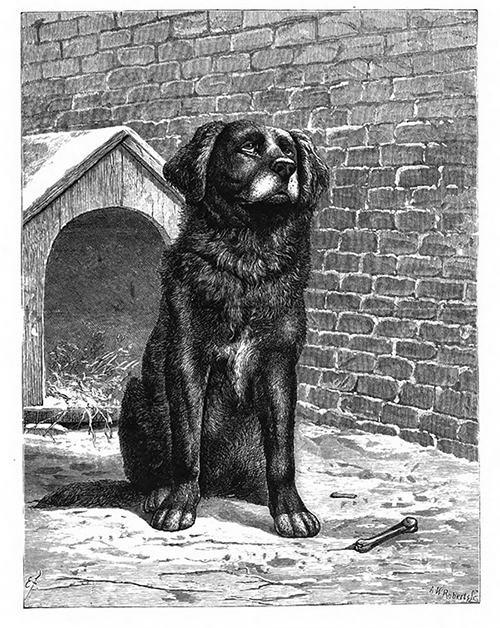
frontispiece
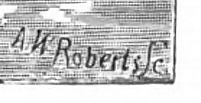
credited to "A. W. Roberts" (no information) in lower right corner,
with what appears to be the letters "S C" following the name.
This was a common abbreviation for the Latin "sculpsit,"
indicating that Roberts was the engraver, not the artist.
This is the only credit to any illustration in this volume
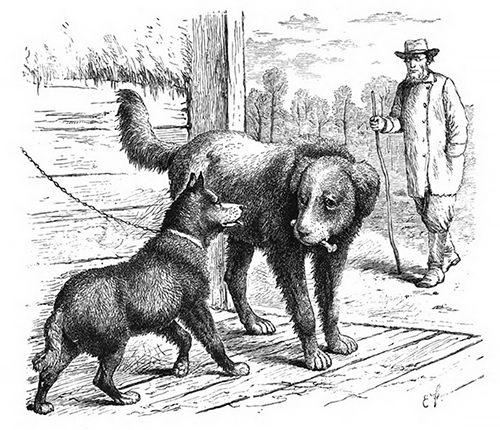
although the next illustration appears to have initials
in the lower right corner
Shimmin begins his account with a tribute to Max's character:
The record of his life was so clean , and his character so free from reproach, that his master and chief mourner has been led to pen a brief memoir of his prime favorite....
Shimmin repeatedly notes Max's love of the water, and recounts several examples of his swimming prowess, though Max — unlike his mother — never had the opportunity to perform a water rescue. Max's early training is discussed — it featured much of the brutality that was common at the time — as is his sagacity, his skill at retrieving, his hatred of cats, and his deep loyalty to Shimmin and his family.
Max was fully
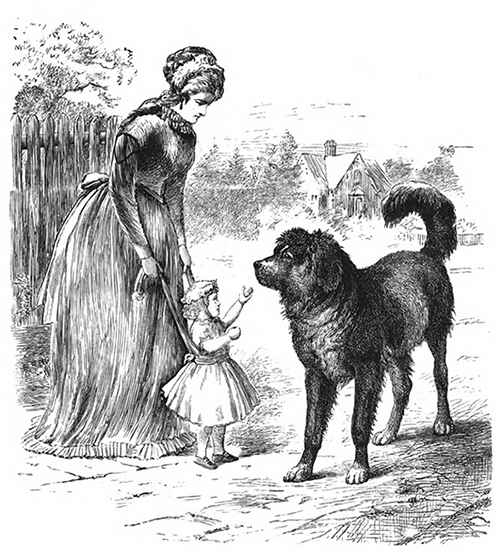
a member of the family, beloved of all, and as great a favorite in the kitchen as the parlor. All the school children knew him by name, and he never tired of running after sticks and snowballs for them, receiving in return a share of their luncheon daily, for he had a sweet tooth for cake or pudding. He used also to visit two schools daily, at the hour of recess, where he had some dear friends who made much of him.
Max disappeared twice during his life, the second time for eleven months, returning in terrible condition. Shimmin writes that he was convinced Max had been taken aboard a ship, though that could never be fully established.
Max's physical deterity early in his life is also noted:
The dog's activity was wonderful, and he was, in his prime, the quickest thing on four feet the writer ever saw, for he has seen him jump the iron fence round the Common six times in as many minutes; he would bring a hoop - stick or hockey from the fork of a tree, twelve to fifteen feet from the ground, his way being to start from a distance and let the impetus carry him up, using his claws in the bark; this he did without any teaching.
Max was equally adept at catching vermin, even besting a terrier in a rat-catching contest.
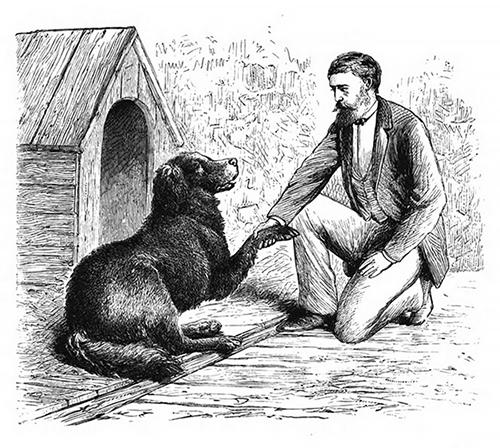
The sweetness of his disposition and endearing qualities are sufficiently attested by the fact, that to the last, when sometimes his sickness entailed additional and disagreeable duties in regard to him, not a servant would hear to his days being shortened, and when he died there were those of the household who felt that though but a dog he had qualities which would have adorned a Christian. He was a
Bayard, sans peur et sans reproche, of his noble race, which has so many illustrious names.
The full text of this work is available here at The Hathi Trust.
Special thanks to Suzanne Price of Old Children's Books in Monmouth, Oregon, for bringing this work to my attention.